MIGIZI teaches Indigenous youth dangers of gas use, importance of advocacy
Interns in MIGIZI’S Green Tech Institute learned about gas use, climate change, and the Minnesota Public Utilities Commission in their winter 2026 cohort.
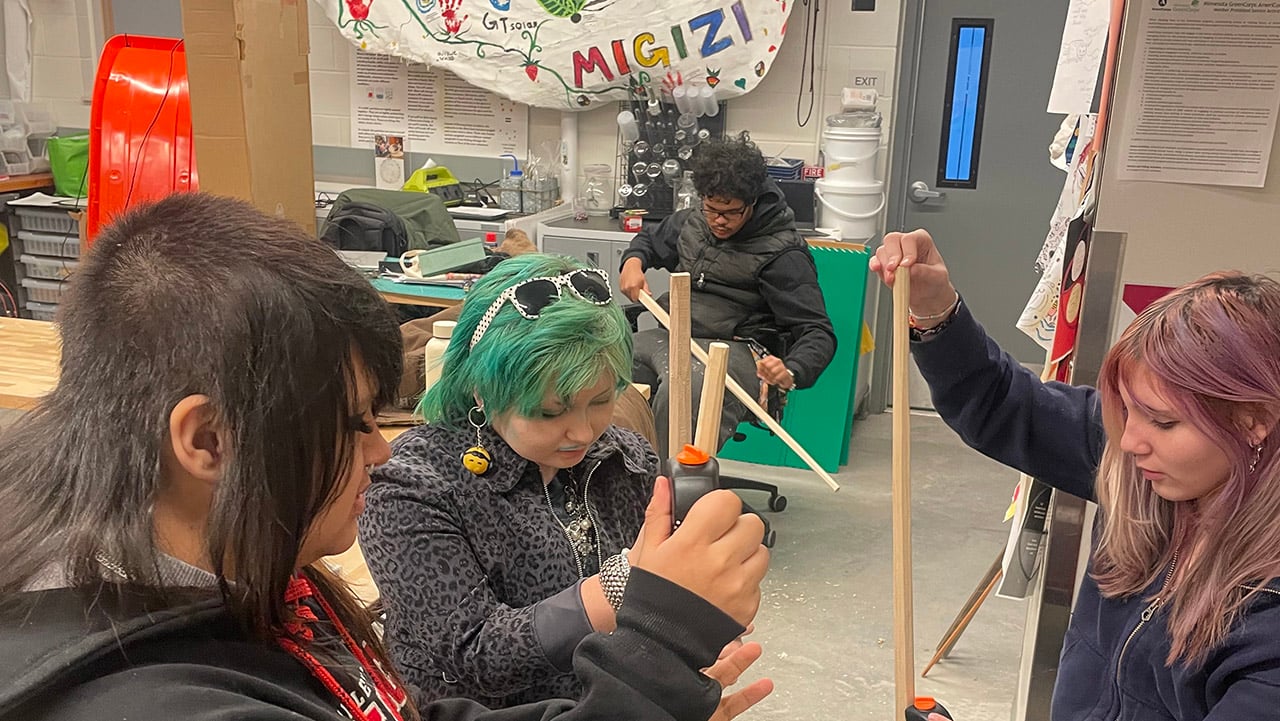
On a winter afternoon in Minneapolis, a group of high school students gathered around wooden tables in a workshop room at MIGIZI, a Twin Cities nonprofit serving American Indian youth, after school. The walls were lined with tools, 3D printers sat waiting in the corner, and student drawings were pinned to the wall and scattered across desks. The students were putting the finishing touches on something that doesn’t often come from a high school classroom: formal written comments to the Minnesota Public Utilities Commission (PUC).
These are the interns of MIGIZI’s Green Tech Institute, a program that compensates Indigenous high school students to learn about STEM (science, technology, engineering, and math) from an Indigenous perspective. The program has taught students how to build and use canoes, make traditional beaded star maps using LED lights, and how transportation policy is related to ecological migrations.
This winter Antavia Paredes-Beaulieu, the Green Tech instructor, designed a program for the interns to learn about natural gas use, its effect on human health and the planet, and how interns could get involved in Minnesota’s energy decision-making process. She invited other organizations in the Clean Heat Minnesota coalition, including Communities Organizing Latine Power and Action (COPAL) and Citizens Utility Board of Minnesota (CUB) to bring in public health experts and community organizers to talk with and teach the students.
After learning about gas use and how the PUC works, the students worked on their individual comments to Commissioners, along with collages and illustrations to showcase their story.
It’s not every day that students get involved in Minnesota’s energy regulatory space, and three students decided to share what they learned.
Tycho came into the Green Tech program already thinking about the environment — solar panels, energy systems, and how things are interconnected. But he didn’t expect to be learning about gas stoves.
“My dad suffers from asthma, and his mom is a chef and baker, so she’s always around gas stoves, and my dad was around them a lot growing up,” Tycho said as he cut out illustrations from a magazine for his collage. “I didn’t know gas stoves could cause health problems for people, and that they have such a bad effect on the atmosphere too.”
After learning about gas stoves, energy use in Minnesota, and how they can file comments to the PUC as they make Minnesota’s energy decisions, Tycho chose to focus on water. He’s interested in how data centers and AI can use massive amounts of freshwater, and wanted to ask Commissioners to consider stricter restrictions on how industries use water.
“Water’s important to me because it’s sacred to me and my family,” he said. “I grew up in Wisconsin, and my dad would bring me to my grandma’s house and we’d go swimming and fishing in Lake Superior. My mom would grow white sage and collect lake water for her plants.”
He remembers the first time he went on a canoe trip with his family in eighth grade, his grandma passed down her teachings of the water and why it’s important. “She said there’s spirits in the water, as there’s spirits in everything. If you treat the water kind, it’ll treat you kind,” Tycho said. His family said a prayer and laid some tobacco down, and the next year they went ricing, they had a lot of rice. “My grandma said this is why you have to treat the water nicely,” he said.
As Tycho learned about gas stoves and water use, he researched statistics on his computer to include in his letter to the PUC. He asked them to stop letting energy industries use too much or pollute water, since humans, fish, animals, and plants all rely on water for life. Then, he began making a collage based on his letter — he had cut out illustrations from magazines of water ducklings, a loon, a gloved hand holding small, green computer chip — to go along with his request.
“I didn’t know much about the PUC before, but I’ve learned they’re sort of a panel of judges that listen to what people want and take action,” Tycho said. Thinking of his dad with asthma, his grandma that used gas stoves so much and taught him about water, he hopes the Commission knows people can’t live with tainted water.
Caylee’s a ninth grader who joined Green Tech last fall and is interested in a career in healthcare, maybe dentistry. She’s fast-working, curious, and not shy to share her feelings — so writing a letter to the PUC about protecting our lakes from pipelines was a piece of cake.
“I grew up with a gas stove, but I never knew how bad it was for my health,” she said while typing her finalized comments onto her computer. She really liked learning from Dr. Curt Nordgaard about gas stoves and childhood asthma. “My cousin has asthma. Knowing that it can be caused by gas stoves makes me more aware. I have a gas stove. It’s like — I should switch to electric or something instead.”
She dove into research and writing for her comment to the PUC, asking regulators to reconsider the pipelines that zig-zag across Minnesota carrying gas that we ultimately use in our homes. “Our lakes are really treasured. They’re one of the most known things about Minnesota,” she said, sharing a statistic about how over 1,300 lakes in Minnesota were negatively affected by pipelines from 2013 to 2019. “I talked about how many lakes my friends and family have gone to, they bring out the fun in us. Pipelines affect our lakes, and they shouldn’t hurt them.”
She also likes drawing — she laid on the desk her the illustration she made of a snake squeezing the state of Minnesota, tears and oil seeping out of the cracks of the fractured state. She’s interested in continuing to advocate for things at the PUC, and she said if there are protests happening, she’s going to be the one making the signs.
Caylee said that she really likes how the Green Tech program has helped them envision what they want to do after high school. She’s visited colleges and college fairs, learning about healthcare programs and dentistry pre-classes. She liked hearing from a health professional about gas stoves in this program.
“Gas stoves are so bad for you,” she exclaimed. “If you have the option to switch it out, do it! Once I move out, I’m going to get an apartment that doesn’t have a gas stove.”
Brian’s a senior who first started the Green Tech program in ninth grade. He has an interest in robotics and wildlife, and like Caylee, he became more interested in pipelines after learning about gas use.
Brian said he learned a lot about gas and oil emissions in the program, how they’re bad for the human body, and how people can write comments to the PUC to share what’s important to them. He hadn’t thought a lot about gas use before, but he became interested once he learned more.
“I didn’t know gas was so bad for you, and that electric stoves are better for you than gas stoves,” he said, sitting at a table in the back of the classroom. He shared that he’s glad he has an electric stove at home. “More houses are going electric because gas is so bad,” he said.
The comment writing was easy, once he got started and did some research. “Pipelines shouldn’t be near water sources. There was a big pipeline breakage in 2010 on a river in Michigan that was really bad,” he said. “I asked the PUC to rethink about where they place pipelines, and what sort of materials they use for them.”
Brian lit up once he started talking about wanting to go to the North Dakota State College of Science in Wahpeton, three hours away. He has a tour lined up this month and is interested in a new program he heard about where scientists are using drones and animatronics to study wildlife.
While he liked writing his comment to the PUC, he’s not sure how interested he is to do it again in the future. “I have an auntie and cousin that was up at the Line 3 pipeline up near Canada when the government was militarizing against the protestors,” he said. “The oil people were using bulldozers and getting really close to people. They made a documentary showing the native communities blocking the pipeline from being built — I thought that was so cool.”
Antavia’s Green Tech Institute at MIGIZI has four cohorts a year, and each one is seasonal. Antavia describes the program as following each season’s purpose: fall is for woodworking and wild ricing, winter for storytelling — like the personal stories students shared with PUC Commissioners.
Antavia’s taught students about native plants, climate change, migration, physics — and each has a tie to traditional Indigenous knowledge. But she’s also teaching the interns how to have agency and find their way in a difficult time of life, too.
“I hope that they see value in self-advocacy, because their voice matters — maybe more than they think,” Antavia said. “When I was a young Native person, I felt like my voice didn’t matter, and I didn’t really know what platform I could use to do advocacy work. I want to create pathways for the interns to make their voice heard and be included in regulatory processes.”
Antavia’s taught students woodworking to build their own knockers to go wild ricing in the fall, incorporated e-tech into traditional beaded skirts they presented at the Advancing Indigenous Science and Engineering Society national conference, and taught physics and climate change while making snow snakes. Each program is hands-on, teaches students both STEM and traditional Indigenous knowledge, and helps support students.
MIGIZI has been an active member in the Clean Heat Minnesota coalition, connecting MIGIZI staff and interns to other grassroots organizations in Minnesota interested in an equitable transition from natural gas to clean energy.
“Teaching the Green Tech interns about the PUC and what they’d like to see in Minnesota’s future was the important thing in this cohort,” said Antavia. “And so was capturing their voices and thinking about how we’re uplifting voices in the community broadly.” Antavia hopes the students will carry their knowledge of STEM and cultural revitalization forward into their career pathway long after they’ve graduated from high school and MIGIZI.
“This was about teaching students to lean into the fire in their belly and develop their own voice and opinions, and giving them a structured outlet for that,” she said. “I hope they can feel included in Minnesota’s regulatory processes. If they’re not, then I at least hope they feel comfortable inserting themselves.”

Interns in MIGIZI’S Green Tech Institute learned about gas use, climate change, and the Minnesota Public Utilities Commission in their winter 2026 cohort.

What many people don’t realize is that utilities generally don’t make money from the gas they sell. Their profits come from infrastructure investments, such as replacing gas lines.

What many people don’t realize is that utilities generally don’t make money from the gas they sell. Their profits come from infrastructure investments, such as replacing gas lines.