When Minnesotans think about affordable, clean energy, they often picture wind turbines or solar panels. But one of the most promising clean energy solutions is already right beneath our feet.
Thermal Energy Networks (TENs) use stable underground temperatures and other local thermal energy resources to provide highly efficient heating and cooling for homes, schools, businesses, and entire neighborhoods. As Minnesota works to lower energy costs, improve reliability, and reduce pollution, TENs are emerging as a practical solution that can deliver all three.
What are Thermal Energy Networks?
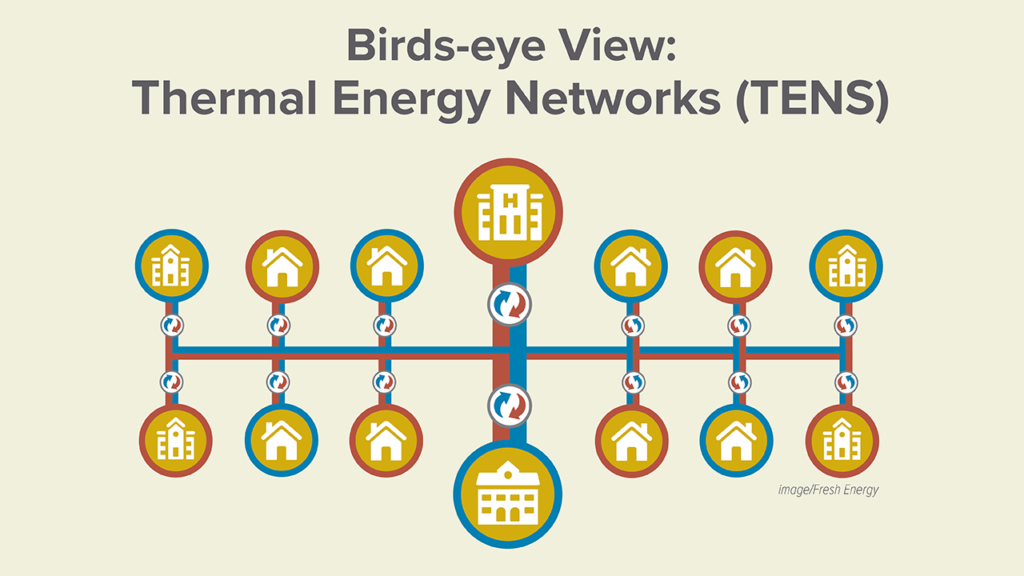
Think of TENs like a neighborhood energy-sharing system. Instead of every building relying on its own gas furnace or water heater, multiple buildings are connected through a shared network of underground pipes that circulate water and transfer heat between buildings and energy sources. Ground-source heat pumps move that energy where it’s needed, providing highly efficient heating in the winter and cooling in the summer.
Unlike individual geothermal systems, TENs allow multiple buildings to share thermal energy through a connected system, which makes clean heating and cooling possible at a larger scale. Because underground temperatures remain relatively constant year-round, these systems are far more efficient than conventional heating and cooling technologies. That means lower energy use, lower operating costs, and greater comfort for residents. Unlike traditional gas pipe infrastructure, TENs do not burn fuel inside homes and buildings. They deliver clean heating and cooling while reducing air pollution and climate emissions. Watch this video from the Building Decarbonization Coalition for a full breakdown on how the technology works.
Why TENs matter for Minnesota
Heating is often one of the largest household energy expenses in Minnesota. Because TENs are highly efficient, they can significantly reduce energy consumption and lower utility costs for families and businesses. Ground temperatures remain stable regardless of weather conditions, allowing TENs to provide dependable heating during Minnesota’s coldest winters and cooling during increasingly hot summers.
Burning fossil fuels, such as methane gas in buildings, contributes to air pollution that can worsen asthma and other respiratory illnesses. TENs eliminate on-site combustion, helping improve air quality while reducing climate pollution.
In addition, building TENs requires skilled workers to design, install, operate, and maintain the systems. In Minnesota, labor organizations, including pipe fitters, laborers, and operating engineers, have shown strong support for TENs because they create long-term, family-supporting jobs. Minnesota pipe fitters are already training members on geothermal well installation, helping prepare the workforce needed to build these projects across the state.
Minnesota is already showing what’s possible
Thermal energy technology is not some far-off concept. Minnesota institutions are already putting it to work. At Macalester College in St. Paul, a new geothermal-powered residence hall is helping lead the transition to cleaner heating and cooling. The college estimates the project will save approximately $71,000 annually in energy costs while reducing reliance on fossil fuels.
Carleton College in Northfield is also part of the growing list of schools implementing campus geothermal system. The college finished the project in 2022 and since 2020, 75% of the campus has been connected to a geothermal district energy grid.
Beyond colleges, projects like The Heights housing development in St. Paul and the Como Zoo will see cost savings and reduce emissions from this technology. St Paul Public Schools are following through on their climate action plan and installing geothermal systems on a couple buildings.
Sabathani Community Center is replacing two boilers and 104 air conditioners with geothermal, solar, and batteries; with an intentional design that could be extended to the surrounding community to create networked geothermal.
Across the state, communities are beginning to explore how neighborhood-scale thermal networks can provide affordable, reliable energy while supporting local economic development. A recent Minnesota Thermal Energy Network Site Suitability Study, released by the Minnesota Department of Commerce and developed in collaboration with partners like the Building Decarbonization Coalition, identifies areas with potential for TEN deployment across Minnesota and examines potential barriers to implementation. The study helps communities identify locations where thermal networks could deliver the greatest benefits and provides a roadmap for future projects.
The Minnesota Public Utilities Commission established a Thermal Energy Network Deployment Work Group at the direction of the Minnesota Legislature to explore how regulated gas utilities could develop thermal energy networks and identify the policies needed to support their deployment. The work group brought together more than 80 stakeholders from over 50 organizations to evaluate the potential benefits, costs, regulatory barriers, rate design options, and broader public impacts of TENs and developed a report with recommendations for the Legislature’s consideration.
Affordable, clean energy isn’t just a future goal; it’s already beneath our feet. TENs offer a practical path toward a more resilient, affordable energy system that works for all Minnesotans. If Minnesota gets TENs right, we could see lower energy bills, more reliable heating and cooling, cleaner air, and thousands of family-supporting jobs in our near future.