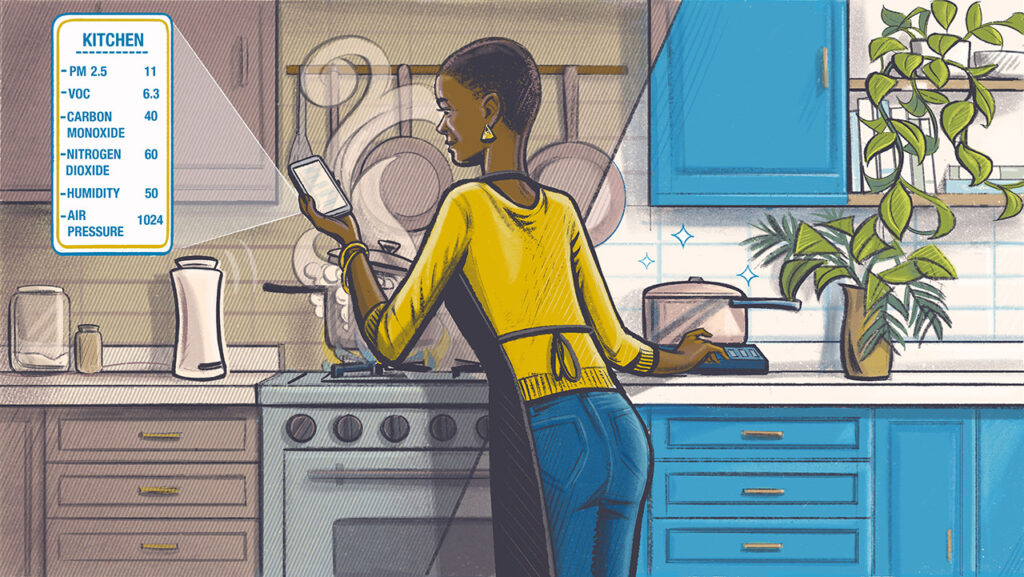
Everyday activities like cooking with a gas stove, burning candles or incense, and using certain household products can release pollution into the air. Outdoor pollution from wildfire smoke, vehicle traffic, and industrial facilities can also make its way indoors. Because we spend most of our time inside, understanding and improving indoor air quality is an important part of creating healthier homes and communities.
In a recent episode of “Qué Onda Minnesota,” a podcast from COPAL (Communities Organizing Latine Power and Action) and hosted by Daniela Granados from COPAL’s Environmental Justice Department was joined by Ayan Diri, policy coordinator at Ayada Leads, and Dr. Curtis Nordgaard, a Twin Cities pediatrician, air quality researcher, and health consultant with the Clean Heat Minnesota coalition, for an in-depth conversation about indoor air quality and its impact on our health. Together, they discussed everything from the health impacts of cooking with gas and the communities most vulnerable to air pollution to practical steps families can take to improve the air inside their homes. The group also discussed Ayada Leads and Clean Heat Minnesota’s work helping Twin Cities families see firsthand how everyday activities affect the air they breathe.
Whether you’re concerned about the air inside your home or simply want to learn more about the connection between our homes, our health, and the environment, this conversation offers valuable insights into the sources of indoor air pollution, simple ways to reduce exposure, and the broader changes needed to ensure everyone has access to clean, healthy air.
Check out some of their conversation below, edited for length and clarity.
Can you tell us about the indoor air quality monitoring program you have supported with Clean Heat Minnesota?
Ayan Diri: In collaboration with Clean Heat Minnesota, Ayada Leads started a project last summer with four participants. Everyone had an air quality monitor placed in their kitchen, near their gas stove. For the first week, participants lived their lives as normal, and during the second week, they used all of the tips and tricks that Dr. Curt had shared to try to reduce indoor air pollution in their homes.
This was specifically for African diaspora families and community members in the Twin Cities, with the goal of getting education and awareness out to the community. Speaking even to my coworkers, a lot of them did not know that gas stoves cause air pollution in their homes, that electric or induction cooking can be a cleaner alternative, or about steps like avoiding burning your food.
We had a lot of interesting takeaways. A lot of people were hesitant to switch away from their gas stove because, as I mentioned earlier, they felt that if they didn’t see a flame, they weren’t really cooking. Some of that comes from concerns about losing their cultural cooking styles. So, a big part of the project has been about education in the community. We had so many community members who wanted to know more, and we’re now in the middle of continuing the project this summer.
Can you tell us some of the most recent research related to indoor air quality?
Dr. Curtis Nordgaard: There are a couple of recent studies looking at the relationship between cooking with gas and pediatric asthma. I bring those up because the question is still raised as to whether they do affect health and again you know we as more research comes out we continue to see a consistent relationship between cooking with gas and pediatric asthma. So, one of those studies was done in Canada, the other in Puerto Rico.
I think the most interesting or exciting study was one that was very published really this summer. The U.S. Environmental Protection Agency, under the Biden Administration, had funded a study to replace gas stoves with electric or induction and look at the impact on asthma. The funding was revoked mid-study by the current EPA. However, the study had progressed far enough they researchers able to analyze the data they had and what they found is after they replaced gas people’s gas stoves, how well controlled their asthma was improved a lot. And that was true for both adults and children.
And so this is important because what a lot of the studies on gas stoves are looking at health associations but this was an actual intervention study. So this is one of the best studies we have showing that replacing your stove can really benefit your health and the health of your family.
For the individual, If you have a gas stove and you rent, you can buy a single induction burner unit for between $50 and $100. It cooks with electricity, although your pan has to be compatible with induction. You can cut down a lot of the cooking-related air pollution from a gas stove by using even one of those as much as possible. There are also two-unit versions that are more expensive, but you can bring these with you when you move. Even if you’re a renter with a gas stove and use two gas burners and one induction burner, that can still cut down on the amount of pollution you’re producing.
Interested in learning more?
Stream the full podcast episode below. You can also learn more about and subscribe to “Qué Onda Minnesota” here.